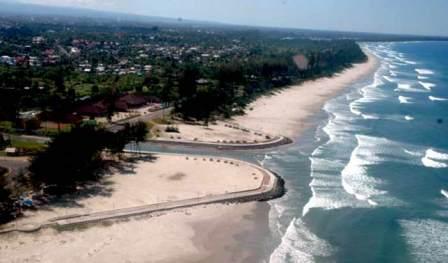
There are no direct international flights
to Bengkulu. You will have to take a flight to Jakarta and then take a
connecting flight to Bengkulu. Alternately, you can also catch regular
buses from Medan, Padang or Jakarta. If you want to go there by bus from
Jakarta, there are two common routes, which are The West Route (Lintas
Barat) takes you from Jakarta to Bandar Lampung and then through dense
tropical jungle of Liwa, Bukit Barisan Selatan National Park, and Krui.
It takes around 22 hours with magnificent ocean view along the way, but
the road condition is not very good and considered unsafe, and the East
Route (Lintas Timur) goes from Jakarta to Bandar Lampung and then enters
Bengkulu via South Sumatra. It's a longer trip (about 25 hours) but
safer.
There are also several Van travel through
the route between Padang and Bukit Tinggi to Bengkulu City and the
journey take around 19-20 hours. Many drivers tend to use the long
journey via Muara Bungo and Sarolangun rather than use the coast road
(Muko-Muko and Painan) which has an 'absolutely with better view and
scenery'.
PALEMBANG
The second largest city in Sumatra after
Medan, is the city of
Palembang, the capital of South Sumatra Province which was once the celebrated seat of the rich and powerful
Sriwijaya empire
that for three centuries - from the 9th to the 11th century - reigned
supreme over the Sumatra seas and up north included the strategic
Straits of Malacca.
Sriwijaya(or Crivijaya empire) was then known as the wealthy trade
hub as well as the center for Buddhist learnings. Monks from China,
India and Java came here and congregated to study the teachings of
Buddha. In AD 671 Chinese chronicles wrote that the famous
Chinese Buddhist monk, I Ching sojourned
in Palembang for six months on his way to India. I Ching wrote that
there were more than 1,000 Buddhist monks in the city and advised
Chinese monks to study Sanskrit in Palembang before proceeding on their
pilgrimage to India.
Later, the great Chinese voyager,
Admiral Cheng Ho, emissary of the Chinese emperor also visited Palembang in the 15th. century. The
Cheng Ho mosque has been constructed here in his honor.
Although structure-wise not much remains to be seen from Sriwijaya's
golden age, Palembang's fine silver and gold songket woven cloths that
are still produced even today, the fine lacquerware it creates for which
Palembang is renowned, and its regal dances and opulent gold costumes
are evidence of its precious royal heritage.
Palembang is situated along the
Musi River, which has its source
deep in the Bukit Barisan mountains, tumbling down to reach the plains
where, fed by the converging Ogam and Komering rivers, it then widens
into a large river as it reaches Palembang. Its many tributaries and
streams that cut through Palembang, caused this town at times to be
called
'The Venice of the East'.
Spanning across the Musi river right in the heart of the city,
the Ampera Bridge
built in 1965 is today's icon of modern Palembang. The view from the
Musi river from this vantage point is breathtaking. Watch vendors on
boats sell their ware at the floating market by the Ampera Bridge, while
at sunset the view with the many houses on stilts along both sides of
the Musi and the centuries' old quaint Chinese shop-houses, are sights
rarely found elsewhere.
Located in the Musi River delta, another precious gem of Palembang is the tiny
island of Kamaro which is adorned with pagodas and Chinese temples. A magnificent
Chinese Temple, the Hok Cing Bio
stands splendidly here. On special occasions, especially on 'Cap Go
Meh' Chinese New Year's celebrations, the island is always packed with
locals and visitors coming from Palembang, Java, Kalimantan and overseas
from Singapore, Malaysia and Thailand.
Another important Landmark of the city is the
Kuto Besak Fortress
which was built during the 17 th century and a legacy of the Palembang
Darussalam Sultanate, that ruled from 1550-1823. Each corner of the fort
is strengthened with bastions. The bastion in the west corner is larger
and similar to other forts in Indonesia while the other three bastions
are architecturally unique, and are unlikely found elsewhere. And as the
sun sets in the afternoon, lights glow around the fort, creating
sparkles that highlight the walls of the fort: truly a sight to be
watched.
Those who wish to take a trip back in time and explore the history of the golden era of Palembang can visit the Sultan
Mahmud Badaruddin II Museum (SMB II)
situated on Musi's Riverbank. Not only is the museum rich in its
collections, but the building itself is a historical legacy, as is a
monument of the heydays of the Palembang Sultanate. Museum Sultan Mahmud
Badaruddin II is a perfect place to explore the history of Palembang.
From the age of
Sriwijaya to the Palembang Darussalam Sultanate,
through the Dutch colonial era and the Japanese occupation up to the
early era of Indonesia's independence are all presented in its 368
collections.
Last, but not the least important is the new
Jakabaring Stadium, the new pride of Palembang, where the 18th Asian Games competitions will be held.
As for
Food and Shopping, Palembang is a treasure trove to
find the best gold and silver songket cloths, laquerware and
woodcarvings. When in Palembang you must not miss to try the city's
specialty of
pempek kapal selam, - or
submarine pempek - bathed in yummy sweet and sour sauce.
To Get There:
Palembang is well connected by air and overland. Palembang's
Sultan Mahmud Badaruddin II International airport connects the city with major cities across the archipelago including: Jakarta, Bandung, Pekanbaru, Batam, Bengkulu, Pangkal Pinang, Yogyakarta, Semarang, and Surabaya.
Among the airlines that serve flights to and from Palembang are Garuda
Indonesia, Batik Air, Citilink, AirAsia, Lion Air, Nam Air, Wings Air,
Xpress Air. There are also international flights to and from Kuala
Lumpur, Malaysia, and from Singapore.
If you are already in one of the cities or capital cities on Sumatra,
an overland trip to Palembang is also possible. The Trans-Sumatra
Highway connects many cities across the island to and through Palembang
which allows you to experience some of Sumatra's natural beuaty along
the way.